03 · FSDP(ZeRO-3):逐层 all-gather 与 reshard¶
上一篇讲的 ZeRO-1 只切了 optimizer state,参数本身仍然是全量常驻在每张卡上的。FSDP(Fully Sharded Data Parallel)在此基础上更进一步,相当于 ZeRO-3:把参数本身也按 DP 维分片,每张卡平时只存 \(1/N\) 的参数,等某一层真正要用到完整参数时,才临时 all-gather 出来,算完立刻 reshard 释放掉。这一篇会对齐 PyTorch FSDP2(也就是
fully_shard)的代码,并和 Megatron 自己的 FSDP 实现做个对比。
代码:_fsdp_param_group.py(unshard/reshard/pre_forward/post_backward),_fsdp_collectives.py(foreach_all_gather/foreach_reduce);Megatron fsdp/、distributed_data_parallel_config.py:90 use_megatron_fsdp。
1. FSDP 的执行骨架:unshard → compute → reshard¶
FSDP 把模型按「FSDP unit」来组织,每个 unit 是一组参数,通常对应一层或者一个 block。每个 unit 在 forward 和 backward 时都会经历同一套生命周期:
flowchart LR
    S0["参数分片\n1/N 常驻"] -->|"pre_forward:\nunshard (all-gather)"| F["完整参数\n(临时)"]
    F -->|"compute fwd"| O["输出"]
    O -->|"post_forward:\nreshard (释放完整参数)"| S1["回到 1/N 分片"]
    S1 -.下游层.-> S1b["..."]
    S1b -->|"pre_backward:\nunshard 再 all-gather"| F2["完整参数"]
    F2 -->|"compute bwd"| G["完整梯度"]
    G -->|"post_backward:\nreduce-scatter"| GS["1/N 梯度分片"]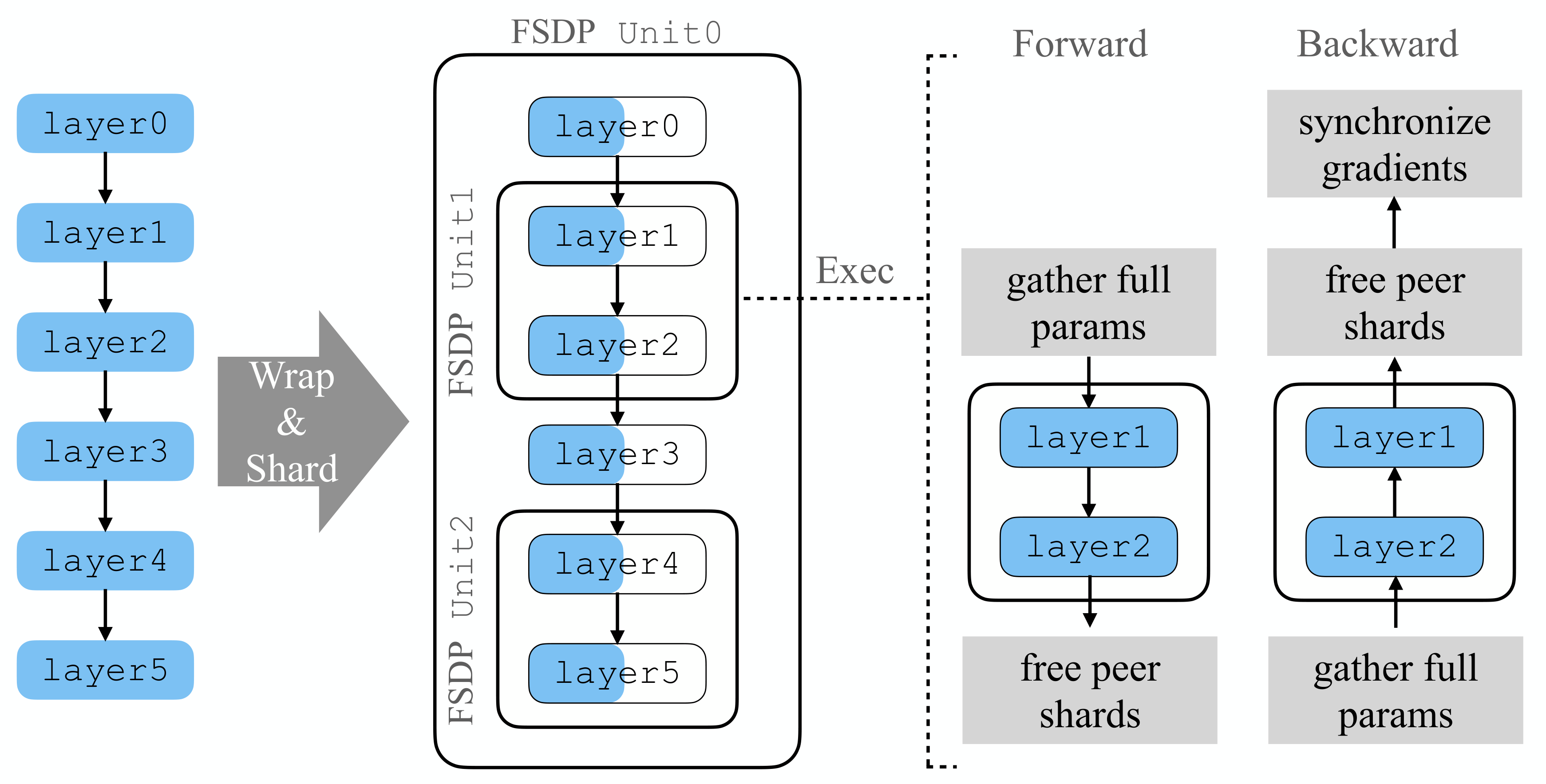
图:FSDP 的 unshard→compute→reshard→reduce-scatter 生命周期。forward 前 all-gather 分片参数物化成完整参数、算完 reshard 释放;backward 再 all-gather 一次算梯度,最后 reduce-scatter 把梯度求和并切回 \(1/N\)。这正是把 ZeRO-3 的「参数随用随取、用完即弃」画成一张时序。(Zhao et al. 2023, Fig 1;arXiv:2304.11277)
def pre_forward(self, ...):          # :344
    self._training_state = FORWARD
    self.unshard(...)                # all-gather 参数
    self.wait_for_unshard()          # 等 all-gather + copy-out 完成
    self._register_post_backward_hook(...)

def post_forward(self, ...):         # :356
    self.reshard()                   # 释放完整参数, 回到 1/N

def unshard(self, async_op):         # :263
    self._all_gather_result = foreach_all_gather(self.fsdp_params, self._all_gather_process_group, ...)
    # foreach_all_gather → dist.all_gather_into_tensor (_fsdp_collectives.py:204)

def reshard(self):                   # :332
    self._to_sharded()               # 丢弃完整参数 buffer

def post_backward(self, ...):        # :391
    ...
    foreach_reduce(..., self._reduce_scatter_process_group, ...)   # reduce-scatter 梯度 (:457)
    # → dist.reduce_scatter_tensor (_fsdp_collectives.py:461)
概括起来,FSDP 把「参数常驻显存」换成了「参数随用随取、用完释放」,本质上是用通信量换显存。具体到每一层,forward 需要一次 all-gather,backward 需要一次 all-gather 加一次 reduce-scatter。
2. reshard_after_forward:显存与通信的权衡¶
FSDP2 有一个关键开关(reshard() 只在 _training_state==FORWARD 时才生效,见 _fsdp_param_group.py:L332–L335):
reshard_after_forward |
forward 后 | backward 时 | 通信/步 | 峰值显存 |
|---|---|---|---|---|
True(默认) |
释放完整参数 | 重新 all-gather | \(\mathrm{RS} + 2\,\mathrm{AG} = 3P\) | 低(只 \(1/N\) 常驻) |
False |
保留完整参数到 backward | 不用再 AG | \(\mathrm{RS} + \mathrm{AG} = 2P\) | 高(完整参数留着) |
这正是 README 第 3 节里讲到的那个权衡。大模型的最外层 unit 通常设成 True 以省显存,但也可以对个别 unit 单独设成 False,比如最后一层,backward 紧接着 forward 发生,设成 False 就能省掉一次 all-gather。
3. overlap 与 prefetch:把 all-gather 藏进计算¶
FSDP 性能能不能打,关键就在于 prefetch 加多 stream 这套机制:
- forward prefetch:算第
i层的同时,异步 all-gather 第i+1层的参数(unshard(async_op=True))。wait_for_unshard 用 CUDA event 让「把 all-gather 结果拷出来」这一步和「下一次 all-gather」overlap 起来,源码注释里明确写着 "overlap current copy-out with next all-gather"。 - backward prefetch:反向算第
i层的同时,异步 all-gather 第i-1层的参数(对应pre_backward里的default_prefetch,:372)。 - 独立 stream:
reduce_scatter_stream(:69)和 all-gather stream 让 RS/AG 与 compute 分别跑在不同的 stream 上、彼此并行,用 CUDA event 来串联它们之间的依赖关系。
sequenceDiagram
    participant C as compute
    participant AG as all-gather stream
    participant RS as reduce-scatter stream
    C->>AG: prefetch layer i+1 params [async]
    C->>C: compute layer i
    AG-->>C: layer i+1 ready
    C->>C: compute layer i+1
    Note over C,RS: backward: 算完 layer i grad → RS(grad) async, 同时 prefetch layer i-1 params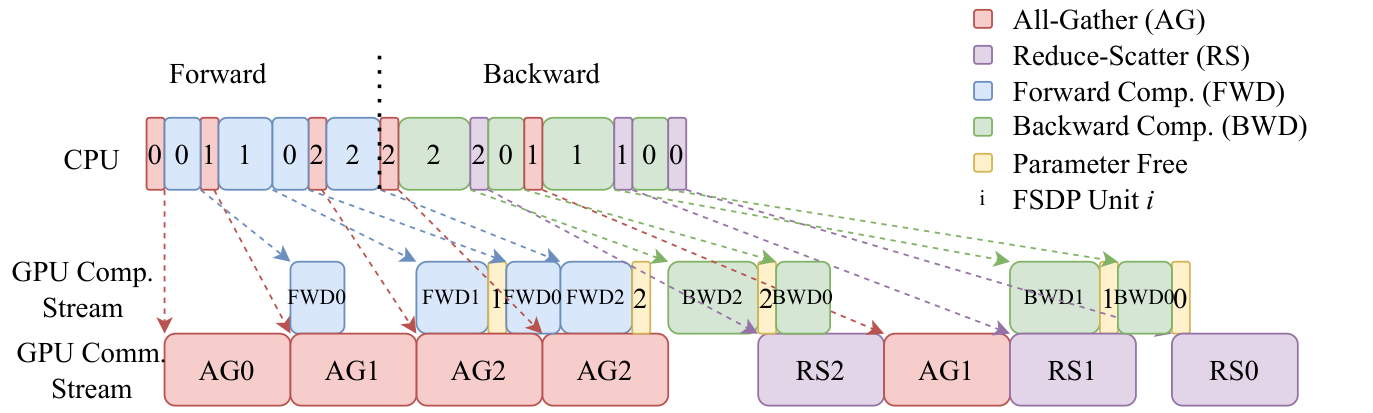
图:FSDP 把 all-gather / reduce-scatter 藏进相邻层计算的时序(原论文 Fig 5)。前向算第
i层时 prefetch 第i+1层参数;反向算梯度时同时 reduce-scatter 并 prefetch 上一层 —— 理想下通信被计算完全覆盖。(Zhao et al. 2023;arXiv:2304.11277)
在理想情况下,AG 和 RS 完全被 compute 盖住,FSDP 的有效成本就约等于纯计算的成本,再加上「参数不常驻」带来的那部分额外 all-gather,而这部分额外开销在被藏住之后会趋近于零。但也有藏不住的情况:层太小导致 compute 时间小于通信时间、带宽太低(比如跨机做 FSDP)、或者 prefetch 深度不够。这些情况下 FSDP 会暴露出通信延迟,效果反而不如 ZeRO-1 加 TP/PP 的组合。
不过 prefetch 也不能一味激进,
limit_all_gathers这个 rate limiter 就是用来防止过犹不及的。如果同时 in-flight 的 all-gather 太多,还没来得及 reshard 的完整参数就会堆积在显存里,甚至触发 CUDA caching allocator 的 blockingcudaMalloc,把「省显存」这个初衷反过来抵消掉。FSDP 的做法是用一个 CUDA event 卡住 CPU 端的发射节奏:最多只允许固定数目(默认是 2 个 all-gather 的块)提前发出去,其余的要等前面的计算把显存消费完之后才放行(FSDP 论文 §3.4「Rate Limiter」的 Fig 6c 给出了实测收益)。这相当于把「prefetch 深度」变成了一个显式的工程旋钮,用深度去换显存峰值。
4. FSDP1(FlatParameter)vs FSDP2(per-parameter)¶
FSDP1(_flat_param.py,旧) |
FSDP2(fully_shard,新) |
|
|---|---|---|
| 分片单位 | 把一个 unit 的所有参数 flatten 成一个大 FlatParameter 再切 |
每个参数独立用 DTensor 表示分片 |
| 灵活性 | 难做 per-param 的 dtype / 冻结 / LoRA | 天然支持 per-param 操作 |
| 通信 | all-gather 整个 FlatParameter | foreach_all_gather 批量 gather 多个 param |
| 状态 | 维护中 | 推荐 |
FSDP2 用 DTensor(分布式张量)把每个参数标注成「沿 dim0 切到 DP mesh 上」的状态,unshard 相当于把这个 DTensor 物化成一份完整的 local tensor,reshard 则是把它丢回 DTensor 的本地分片。因为 TP 同样也用 DTensor 来表示分片,这让 FSDP 能和 TP 组合成 2D parallel(对应的 device mesh 是 [dp, tp])。
5. Megatron-FSDP¶
Megatron 自己也提供了一套 FSDP 实现(对应配置项 use_megatron_fsdp / use_custom_fsdp,见 distributed_data_parallel_config.py:90/93;data_parallel_sharding_strategy,:100):
data_parallel_sharding_strategy取值对应 ZeRO 级别:'no_shard'(DDP)、'optim'(ZeRO-1)、'optim_grads'(ZeRO-2)、'optim_grads_params'(ZeRO-3/FSDP)。- 复用了 01 里那套连续
_ParamAndGradBuffer基础设施(start_param_sync逐 bucket 做 all-gather,其实就是 FSDP 的 unshard),并在此基础上加了一些优化,比如fsdp_double_buffer(:135)用于显存复用、megatron_fsdp_cuda_graph_mode(:218)等。 - 好处是可以和 Megatron 的 TP/PP/EP、
main_grad/wgrad fusion、distributed checkpoint 无缝集成,不需要像用 torch FSDP 那样重新适配一遍 Megatron 自己的 buffer 体系。
该怎么选:如果是纯 DP,或者 DP+TP 的 2D 组合,且整体生态用的是 torch,选 torch FSDP2 比较顺手;如果已经在 Megatron 里做了 TP/PP/EP,那么 Megatron-FSDP 或者 ZeRO-1 的 distributed optimizer 会更合适,多数情况下 ZeRO-1 加 TP/PP 的通信开销比纯 FSDP 更省。
6. FSDP 与 ZeRO-1+TP/PP 的选型¶
| 场景 | 推荐 |
|---|---|
| 模型能放下、只缺 optimizer 显存 | ZeRO-1(distributed optimizer),通信最省 |
| 模型放不下、不想要 TP/PP 的代码复杂度、单/少机高带宽 | FSDP(ZeRO-3) |
| 超大模型、多机、要极致 MFU | ZeRO-1 × TP × PP × (CP/EP),FSDP 仅用于最外层 DP |
| RL / post-training(slime 等)、模型中等、要简单 | FSDP 常见 |
参考¶
- Zhao et al., PyTorch FSDP: Experiences on Scaling Fully Sharded Data Parallel, 2023. arXiv:2304.11277
- PyTorch FSDP2 源码:
_fully_shard/。 - Megatron-FSDP:
fsdp/,distributed_data_parallel_config.py:L90–L260。
把 DDP、ZeRO-1、FSDP(ZeRO-3)这三种机制都讲完之后,下一步自然是亲手实现一遍:做 dp_lab.ipynb,手写 DDP(all-reduce grad)、ZeRO-1(shard optim + RS grad + AG param)、ZeRO-3(shard param + unshard/reshard)这三种方式,逐元素验证它们都和单进程训练等价。