01 · Router 与 Dispatch 前的 Preprocess¶
本篇承接上一篇的全景介绍,展开 forward 通路的第一段:从
hidden_states到routing_map/probs,再到 dispatch 所需的全部 metadata(input_splits/output_splits/tokens_per_expert)。这一段几乎全部是本地计算加上少量小张量的 D2H 拷贝,没有大张量通信,但它决定了后面 all-to-all 的所有 shape,也藏着 MoE 训练中最隐蔽的性能问题——CPU-GPU 同步点。代码锚点:
router.py、moe_utils.py、token_dispatcher.py::preprocess。
1. Router 的两步:gating 与 routing¶
TopKRouter(router.py:L138)的 docstring 对命名约定有清楚的说明,这里先列出来,全文沿用:
logits      router gating 网络的原始输出          [T, E]
scores      过 score function 后、用于选 expert 和算 aux loss 的分数   [T, E]
probs       top-k 权重,用于 combine 时加权求和      [T, E] (稀疏) 或 [T, topk]
routing_map token↔expert 的 bool mask              [T, E]
其中 \(T =\) num_tokens(\(= S/\mathrm{TP} \times B\)),\(E =\) num_moe_experts。
1.1 gating:一个 fp32 的小 linear¶
Router.gating(router.py:L86–L108):
infra 上值得注意的三点:
- router 权重是 fp32(
router.py:L60–L62,weight: \([E, H]\))。即使模型主体使用 bf16,gating 也强制走高精度,因为 top-k 的边界对噪声极其敏感——两个 logits 差几个 ULP 就可能换一个 expert,进而改变整个 dispatch 的 layout。moe_router_dtype可设fp32/fp64(router.py:L103–L106)。 router_gating_linear(moe_utils.py:L1320)背后是自定义 autogradRouterGatingLinearFunction(moe_utils.py:L1237),其目的是在 forward 中用 fp32 计算 matmul,同时避免把 fp32 中间激活长期保留在显存里,backward 时再重算或转换,以节省显存。- gating 没有 TP 切分——
weight以 \([E, H]\) 的形式完整复制在每个 rank 上,因为 \(E\) 不大(几百量级),而各 rank 本来就持有完整 hidden 维的输入,logits 在本地即可算全。
1.2 routing:score function、top-k 与负载均衡¶
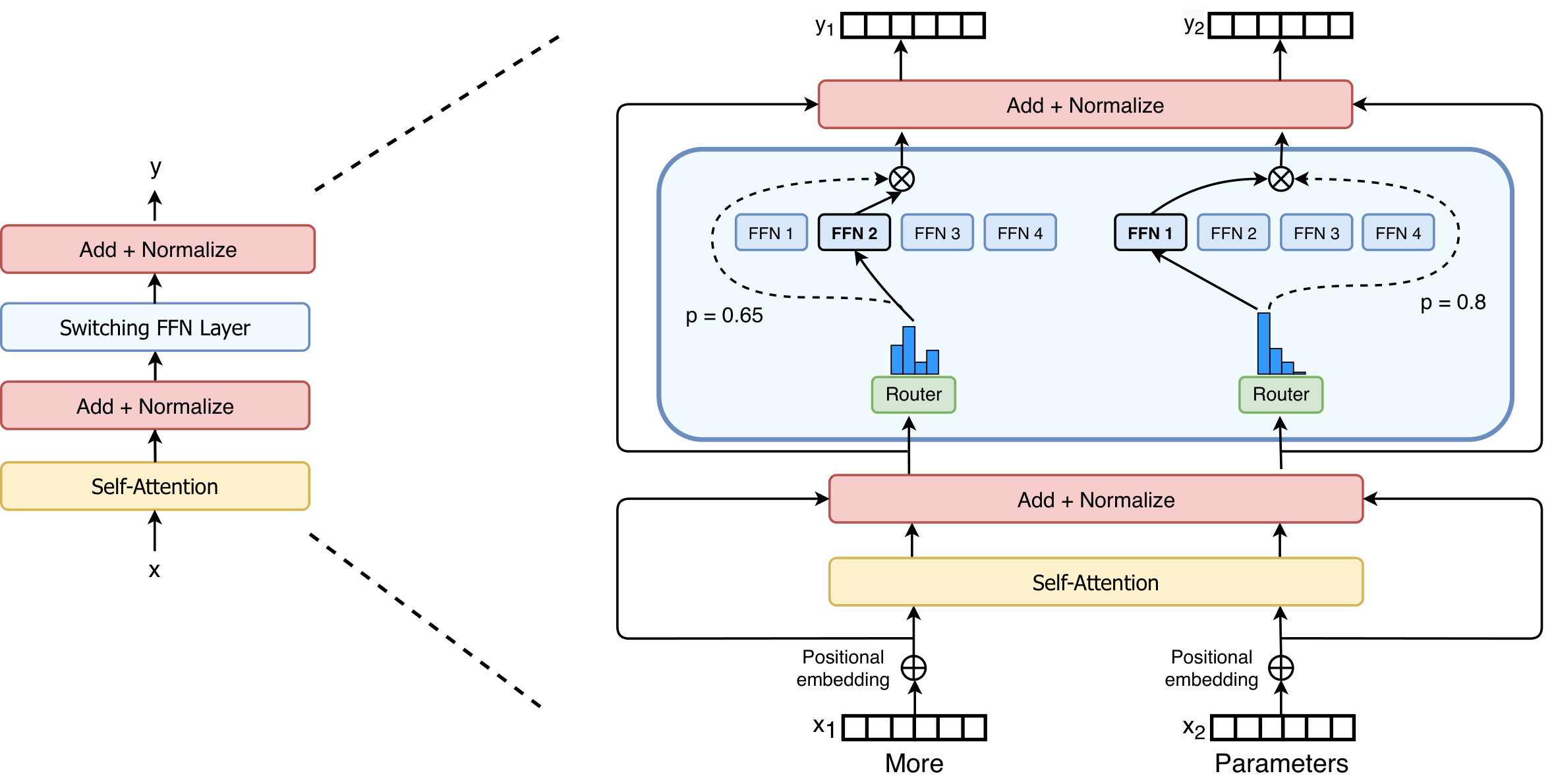
图:MoE routing 的经典示意(Switch Transformer)。router 对每个 token 算一组 gate 分数,把 token 送到得分最高的 expert FFN(Switch 是 top-1,DeepSeek 等是 top-k)。下面的
routing_map/probs正是这张图里「哪个 token 去哪些 expert、各占多少权重」的张量化表示。(Fedus et al. 2021, Fig 2;arXiv:2101.03961)
核心是 topk_routing_with_score_function(moe_utils.py:L672),可以拆成四步:
flowchart LR
    L["logits [T,E]"] --> SF
    SF["score function\nsoftmax / sigmoid / sqrtsoftplus"] --> EB
    EB["+ expert_bias\n(aux-loss-free balance)"] --> GL
    GL["group_limited_topk\n(可选, DeepSeek-V3)"] --> TK
    TK["top-k 选择"] --> NM["归一化 → probs\n构造 routing_map (bool)"]
先明确输入输出的 shape 和语义,再逐步展开。logits \([T, E]\) 是上一步 gating 的输出——第 \(t\) 行第 \(e\) 列是 token \(t\) 对 expert \(e\) 的原始打分,未经任何归一化。routing 要从这个 \([T, E]\) 矩阵产出两样东西:
routing_map\([T, E]\) bool —— 每行恰好topk个 True,标记 token 选了哪几个 expert(离散选择,不可导)。probs\([T, E]\) 稀疏 —— 被选中位置上是归一化后的权重,combine 时加权求和用(连续权重,可导)。
中间量 scores = score_function(logits),选 expert 和算 aux loss 都基于它。三个 score function 的本质差异在于「沿哪个维度归一化」:
# topk_routing_with_score_function, moe_utils.py:793-818(精简)
if score_function == "softmax":
    if use_pre_softmax:                       # 先归一化、再选
        scores = softmax(logits, dim=-1)      # 沿 E 维:E 个 expert 争一个 token,每行和=1
        probs, idx = topk(scores, topk, dim=1)
    else:                                     # 先选、再归一化(默认)
        scores, idx = topk(logits, topk, dim=1)   # 直接在原始 logits 上选 top-k
        probs = softmax(scores, dim=-1)       # 只对选中的 k 个分数归一化 → 和=1
elif score_function == "sigmoid":             # DeepSeek-V3
    scores = sigmoid(logits.float())          # 逐元素:每个 (t,e) 独立打分,expert 之间不竞争
    scores, idx = topk(scores, topk, dim=1)
    probs = scores / (scores.sum(-1, keepdim=True) + eps)   # topk>1 才归一化
# 最后:把 idx 处置 True 得 routing_map;把 probs scatter 回 [T,E] 得 routing_probs(:836-837)
两个高频混淆点:
- softmax 沿
dim=-1(expert 维)作用,是 token 内部「\(E\) 个 expert 竞争」;sigmoid 则是逐元素的,expert 之间没有竞争,各自独立判断「要不要这个 token」。sigmoid 的数值更平、对 top-k 边界更鲁棒,所以 DeepSeek-V3 采用它,再依靠后面的求和归一化把 \(k\) 个权重凑成和为 1。 use_pre_softmax:先 softmax 再 top-k(probs 取自全 \(E\) 归一化,\(k\) 个权重之和 < 1),还是先 top-k 再 softmax(只对 \(k\) 个归一化,和 = 1)。两种顺序的数值不同,是复现其他实现配置时容易出错的地方。
逐项说明:
- score function(
score_function ∈ {softmax, sigmoid, sqrtsoftplus})。DeepSeek-V3 用sigmoid:每个 expert 独立打分,不做 token 维上的归一化竞争,配合后面的归一化更稳定。use_pre_softmax控制是先 softmax 再 top-k,还是先 top-k 再归一化。 - expert_bias(
router.py:L173–L194,enable_expert_bias):这是 DeepSeek-V3 提出的 aux-loss-free load balancing。实现上维护一个 per-expert 的expert_bias,只在选择 top-k 时加到分数上,不进入 probs。代码把这一区分表达得很明确(moe_utils.py:L805–L808):
scores_for_routing = scores + expert_bias        # 只用来选谁
_, top_indices = compute_topk(scores_for_routing, topk)
scores = torch.gather(scores, dim=1, index=top_indices)  # probs 仍取自「无 bias」的 scores
也就是说,bias 改变的是选择哪些 expert,而加权用的权重仍然取自原始 score,因此它只是调整路由,不影响前向数值。训练中根据每个 expert 实际收到的 token 数动态增减 bias(get_updated_expert_bias, moe_utils.py:L1079):过载的 expert 调低 bias,欠载的调高,从而在不向 loss 引入额外扰动项的情况下把负载拉平(与 §2 的 aux loss 是两条互补的路线)。local_tokens_per_expert buffer(router.py:L175)负责累计这一统计。
- group_limited_topk(moe_utils.py:L579):见下节。
- 归一化:选出的 top-k 个分数归一化成和为 1(或乘 scaling_factor),得到 probs;同时把 top-k 的位置在 \([T, E]\) 上置 True 得到 routing_map。
1.3 group-limited routing 与 all-to-all 扇出¶
group_limited_topk(moe_utils.py:L579–L634)从 infra 视角看是最重要的 routing 变体,因为它直接决定跨机通信量:
# 1. E 个 expert 分成 num_groups 组
# 2. 每组的代表分 = 组内 top-(topk/group_topk) 分数之和
group_scores = scores.view(T, num_groups, -1).topk(topk // group_topk, dim=-1)[0].sum(dim=-1)
# 3. 每个 token 只保留 group_topk 个组,其余 mask 成 -inf
group_idx = torch.topk(group_scores, k=group_topk, dim=-1)[1]
# 4. 在保留的组内再选 top-k 个 expert
masked_scores = scores.masked_fill(~score_mask.bool(), float('-inf'))
probs, top_indices = torch.topk(masked_scores, k=topk, dim=-1)
两种典型用法(docstring moe_utils.py:L595–L602):
- device-limited:
num_groups = EP,每 token 的 expert 限制在少数几个 device 上(DeepSeek-V2)。 - node-limited:
num_groups = EP group 里的 node 数,每 token 的 expert 限制在 ≤group_topk个 node 上(DeepSeek-V3,通常group_topk=4)。
为什么 infra 关心它:没有 group 限制时,top-8 的 8 个 expert 可能散落在 8 个不同的 node 上,dispatch 需要向 8 个 node 发送数据;加了 node 限制后最多发往 4 个 node,跨机 RDMA 流量减少约一半。DeepEP 的「asymmetric-domain bandwidth forwarding」(NVLink 到 RDMA 的转发,见 MoE 章 06 · DeepEP:V1 (legacy/NVSHMEM) 与 V2 (elastic/NCCL Gin))正是针对这种 node-limited 模式做的优化。
2. aux loss:定义、梯度与反向注入¶
负载均衡的另一条路线(与 §1.2 的 expert_bias 互补)是经典的 auxiliary load balancing loss(switch_load_balancing_loss_func, moe_utils.py:L56)和 z-loss(z_loss_func, moe_utils.py:L146)。本节先给出这两个 loss 的定义,再介绍 infra 上一个精巧的「梯度注入」设计。
2.1 aux loss 的定义与梯度¶
为什么需要 aux loss:top-k 是离散选择,「token \(t\) 该不该选 expert \(e\)」这一步不可导(见 §7)。如果放任不管,router 会塌缩到只使用少数几个 expert(富者愈富),其余 expert 几乎收不到 token,算力被浪费。aux loss 是一个可导的负载均衡 surrogate:用连续的 probs 替代不可导的 token 计数,惩罚概率质量的过度集中。
switch_load_balancing_loss_func 的定义(docstring 给了完整推导,moe_utils.py:L70–L95):
其中 \(f_i\) 是 expert \(i\) 实际分到的 token 比例(离散计数,不可导),\(P_i\) 是 router 给 expert \(i\) 的平均概率(连续,可导)。直观地说,\(f_i\) 是「真实负载」,\(P_i\) 是「router 想给的负载」。点积 \(\sum_i f_i P_i\) 在完全均衡(每个 \(f_i = P_i = 1/E\))时取最小值 \(1/E\),分布越偏斜值越大。关键在于梯度只流经可导的 \(P_i\)(即 probs),而把 \(f_i\) 当作常数权重:
也就是说,某个 expert 如果已经过载(\(f_i\) 较大),它对应的 probs 就会受到更大的正梯度而被压低,下一步分到的 token 随之减少;欠载的 expert 则相反。\(\alpha =\) moe_aux_loss_coeff。
代码实现是这个定义式的等价变形(moe_utils.py:L139–L143):
aux_loss = sum(probs.sum(dim=0) * tokens_per_expert) \
           * (num_experts * coeff / (topk * total_num_tokens**2))
#          └── Σ_i (Σ_t probs[t,i]) · n_i ──┘   ×  E·α / (topk·T²)
# 把 f_i 的 1/(T·topk) 与 P_i 的 1/T 两个归一化常数合并提到括号外 → 与上面定义式等价
tokens_per_expert \(= n_i =\) routing_map.sum(0)(§3 还会用到)是 detach 的整型计数,不带梯度;梯度全部经 probs.sum(0) 这一项回到 router。
z-loss(z_loss_func, moe_utils.py:L146,出自 ST-MoE)是另一个正则项,约束 logits 的规模不要过大:
\(\operatorname{logsumexp}_e(\mathrm{logits})\) 正是 softmax 分母的对数;惩罚它的平方相当于把 logits 的整体尺度往下压,防止 router 输出过大、softmax 饱和。
这两个 loss 都是标量。剩下的问题是它们如何参与 backward,这正是下面 autoscaler 机制要解决的。
2.2 MoEAuxLossAutoScaler:将旁路 loss 的梯度注入主图¶
MoEAuxLossAutoScaler(moe_utils.py:L246)是个 autograd.Function:
class MoEAuxLossAutoScaler(torch.autograd.Function):
    @staticmethod
    def forward(ctx, output, aux_loss):
        ctx.save_for_backward(aux_loss)
        return output                     # forward 透传,不改变数值

    @staticmethod
    def backward(ctx, grad_output):
        (aux_loss,) = ctx.saved_tensors
        aux_loss_grad = torch.ones_like(aux_loss) * scale
        return grad_output, aux_loss_grad # 给 aux_loss 注入梯度
它的机制是:forward 时把 router 的某个输出张量在这个 function 里「过一遍」(数值不变),同时把 aux_loss 标量挂进来。backward 时,主 loss 的梯度照常透传给 output,而 aux_loss 被人为赋予一个 ones * scale 的梯度,于是 aux loss 的梯度会自动沿着 router 的计算图回传,无需手动把 aux loss 加到 total loss 上,也无需第二次 backward。scale 由 grad scaler 和 token 数决定(set_loss_scale, moe_utils.py:L286)。
这是 MoE 训练中把旁路 loss 的梯度注入主计算图的标准技巧。看代码时如果不了解 autoscaler,很容易误以为 aux loss 没有生效。
3. Token dropping 与 capacity¶
routing 完成后得到 routing_map \([T, E]\),每列(每个 expert)上 True 的数量就是该 expert 在本 rank 收到的 token 数。这个数是数据相关的,各 expert 互不相等。处理这种不均衡有两条路线:
3.1 dropless¶
dropless 是默认选项,也是训练的主流做法:不丢弃任何 token,num_out_tokens \(= T \times \mathrm{topk}\)(固定,token_dispatcher.py:L530)。每个 expert 收到多少 token 就计算多少,由 grouped GEMM 处理变长输入。优点是不损失信息;代价是 GEMM 的 \(M\) 维是动态的,且必须 padding 到对齐边界(见 MoE 章 05 · Grouped GEMM 与 Expert 计算)。
3.2 drop-and-pad¶
moe_pad_expert_input_to_capacity=True 时(token_dispatcher.py:425, 491),给每个 expert 一个固定 capacity:
capacity = get_capacity(num_tokens = T*topk, num_experts=E, capacity_factor=f)   # moe_utils.py:203
# 每个 expert 固定 capacity 个槽位:超出的 token 丢弃,不足的 padding
num_out_tokens = capacity * E
get_capacity(moe_utils.py:L203)的计算是 ceil(num_tokens / num_experts * capacity_factor) 再向上对齐。drop-and-pad 最大的价值在于所有 shape 在 CPU 侧都是静态可知的,因此不需要 D2H sync,也可以被 CUDA graph 捕获(permute 里 drop_and_pad 分支用 argsort 取固定 capacity 个,moe_utils.py:L386–L407)。
两者的取舍是:dropless 精度更好,但存在动态 shape 和 sync 开销;drop-and-pad 对 CUDA graph 和推理更友好,但会丢弃 token。训练多采用 dropless,推理 decode 多采用 capacity/masked 方式。
4. Preprocess:从 routing_map 计算通信 metadata¶
这是 MoEAlltoAllTokenDispatcher.preprocess(token_dispatcher.py:L475–L596)所做的事情,也是最容易被忽略、却对性能影响最大的一段。它的目标是从 routing_map \([T, E]\) 算出 all-to-all 需要的 input_splits / output_splits,以及每个 local expert 的 token 数。
# [E] 本 rank 发出token给global expert的接受情况
num_local_tokens_per_expert = routing_map.sum(dim=0).long()              # :517

# [EP] 本 rank 发给每个 EP rank 的 token 数
#   = 把 E 个 expert 按 (ep_size, num_local_experts) 分块后按 expert 维求和
self.input_splits = num_local_tokens_per_expert.reshape(
    self.ep_size, self.num_local_experts).sum(axis=1)                    # :537

# 跨 rank 收集全局分布,得到「本 rank 会从每个 EP rank 收到多少」
num_global_tokens_per_expert = gather_from_sequence_parallel_region(
    num_local_tokens_per_expert, group=self.tp_ep_group) ...             # :544
self.output_splits = num_global_tokens_per_rank[self.tp_rank]            # :560
num_tokens_per_local_expert = num_global_tokens_per_local_expert.sum(dim=(0,1))  # :566
ASCII 直观图(EP=2,每 rank 2 个 local expert,E=4):
rank0 的 routing_map.sum(0)  →  num_local_tokens_per_expert = [e0:30, e1:10, e2:5, e3:25]
                                          │            │
       发给 rank0 的 (e0,e1)  ───────────┘            └────── 发给 rank1 的 (e2,e3)
       input_splits[0] = 30+10 = 40                    input_splits[1] = 5+25 = 30

       input_splits  = [40, 30]      # 本 rank 发出去的拆分
       output_splits = [..,..]       # all-gather 后才知道:本 rank 会收到多少(来自各 rank)
input_splits 在本地就能算出来,但 output_splits 必须等一次小的 all-gather(gather_from_sequence_parallel_region)拿到全局分布之后才能确定,因为「本 rank 会收到多少」取决于其他 rank 发过来多少。这就引出下一个关键问题。
5. CPU-GPU sync point¶
all-to-all(variable split)需要把 input_splits / output_splits 以 CPU int list 的形式传给 NCCL,但这些值是在 GPU 上算出来的,因此必须做一次 device 到 host 的拷贝并同步,CPU 才能拿到具体数值。这个 sync 会打断 GPU 的异步流水,是 MoE 训练中常见的性能瓶颈。
Megatron 用一套「sync point 调度」把这个同步推迟到最晚必要的时刻,并放到独立 stream 上和主计算 overlap。看 token_dispatcher.py:L436–L444:
self.cuda_sync_point = "no_sync"
self.cuda_sync_point_priority = {
    "before_permutation_1": 0,   # 最早
    "before_ep_alltoall":   1,
    "before_permutation_2": 2,
    "before_finish":        3,
    "no_sync":              4,   # 最晚 / 不需要
}
self.cuda_dtoh_point = "before_permutation_1"   # D2H 拷贝发起点
逻辑(_maybe_update_cuda_sync_point :882、_maybe_dtoh_and_synchronize :893):
- dropless 静态 shape:
num_out_tokens\(= T \times \mathrm{topk}\) 在 CPU 侧已知,唯一需要 sync 的是 all-to-all 的 splits,因此 sync point 设到before_ep_alltoall(:570)——也就是尽量避免同步,必须同步时也推迟到 A2A 之前的最后一刻。 - token dropping / quantization padding:
num_out_tokens是动态的,必须更早 sync(before_permutation_1,:526)。 - D2H 拷贝在专门的
cuda_dtoh_stream(:450)上发起,record_stream后让主 stream 继续运行,到 sync point 才event.synchronize()(:926-930),这样 D2H 的延迟就被主计算掩盖了。
要点:
input_splits/output_splits/num_out_tokens/num_global_tokens_per_local_expert这几个小张量的 D2H 是 MoE 训练中真实存在的串行点。Megatron 的策略是批量拷贝、推迟同步、再用侧 stream 做 overlap。DeepEP 在dispatch里也有同样的问题——它内部会让 CPU 等待 GPU 的信号来拿到接收 token 数(见 02 · Dispatch:permute、all-to-all、buffer 分配 与 MoE 章 06 · DeepEP:V1 (legacy/NVSHMEM) 与 V2 (elastic/NCCL Gin)),这正是 DeepEP normal 模式「不兼容 CUDA graph,除非用num_worst_tokens」的原因。
6. DeepEP 路径下的 routing:topk indices¶
走 MoEFlexTokenDispatcher + DeepEP 时,routing 的产物形式不同。_DeepepManager.setup_metadata(token_dispatcher.py:L1218–L1228):
# DeepEP 要的是 [T, topk] 的稠密 indices,而不是 [T, E] 的 bool map
self.token_probs, self.token_indices = torch.topk(probs, self.router_topk, dim=-1)
if self.capacity_factor is not None:          # 被 drop 的 token 用 -1 标记
    mask = self.token_probs == 0
    self.token_indices = self.token_indices.masked_fill(mask, -1)
token_indices\([T, \mathrm{topk}]\),dtypeint64(deep_ep.topk_idx_t),-1表示「不选任何 expert」(被 drop 的 token)。token_probs\([T, \mathrm{topk}]\),DeepEP 只接受 fp32 probs(token_dispatcher.py:L1236–L1242会强制.float())。
这个 \([T, \mathrm{topk}]\) 的 topk_idx 正是 DeepEP get_dispatch_layout(topk_idx, num_experts) 的输入(legacy.py:L293)——DeepEP 在 GPU kernel 里自己算 num_tokens_per_rank / num_tokens_per_expert / is_token_in_rank,把第 4、5 节那套 metadata 计算下沉到了通信库里。这是 flex 路径相对原生 A2A 的一个简化点:Megatron 不再需要自己计算 splits。
7. 本段的 forward / backward 小结¶
| 子步骤 | forward | backward |
|---|---|---|
| gating linear | fp32 matmul \(x W_g^{\top}\) | RouterGatingLinearFunction.backward,可能重算 |
| score + top-k | 不可导的 top-k 选择(选哪些 expert)+ 可导的归一化(probs 的值) | 梯度只流经被选中的 top-k 位置的 probs;选择本身不回传梯度 |
| aux loss | 算标量 aux_loss,过 MoEAuxLossAutoScaler(数值透传) |
autoscaler 注入 ones*scale 梯度,aux loss 沿 router 图回传 |
| preprocess (splits) | GPU 算 splits + D2H sync | 纯 metadata,无梯度 |
注意:top-k 的「选择」是不可导的,梯度不会告诉 router「应该选别的 expert」。router 的学习完全依赖两个信号:一是被选中 expert 的 probs 权重梯度,二是 aux loss 和 expert_bias 提供的负载均衡信号。这是 MoE router 训练不稳定的根源,也是各种 score function 与 balancing 技巧存在的原因。
讲完 router 怎么产出 routing_map 和通信所需的 metadata,接下来的问题自然是:这些 token 具体是怎么被搬到目标 rank 上的?请看 02 · Dispatch:permute、all-to-all、buffer 分配,里面会展开 permute 的两次重排、all-to-all 的真实通信过程,以及 DeepEP 的 fused dispatch 如何把这一切打包成一个 kernel。