Expert Parallelism (EP)¶
本篇是 EP 一章的总览。本文会先给出 MoE/EP 数据通路的完整定义(token 到 expert 的 dispatch/combine、各中间量的 shape、前反向对称性),再把整条 forward / backward 按工程实现逐段拆开,对齐到 Megatron-LM、DeepEP、DeepGEMM 的真实代码。
前置知识¶
- 熟悉 Transformer FFN 与 top-k routing 的基本想法;架构侧的定义(细粒度、LatentMoE、aux / aux-free / QB)见 MoE。
- 了解 all-to-all 集合通信,参见 集合通信:原语、算法、NCCL 实现与拓扑映射。
1. MoE layer 的 forward 通路¶
先把整条链路画出来。下面是 Megatron MoELayer.forward(moe_layer.py:L598–L683)的四个 main step,注释里的步骤名直接对应 MoETokenDispatcher 的抽象方法。
flowchart TD
    X["hidden_states\n[S, B, H]"] --> R

    subgraph S1["1. Routing & Preprocess (本地计算, 无通信)"]
        R["router.gating: logits = x @ W_g^T\n[T, E]"] --> RT["routing: top-k + score_func\n→ probs, routing_map"]
        RT --> PP["preprocess: 算 input/output splits,\ntokens_per_expert (metadata)"]
    end

    PP --> D
    subgraph S2["2. Dispatch (跨 EP rank 通信)"]
        D["dispatch_preprocess: permute-1\n(按 expert 把本地 token 排序)"] --> A2A1["token_dispatch: all-to-all (EP)\n把 token 送到 expert 所在 rank"]
        A2A1 --> DP["dispatch_postprocess:\n(可选 AG over TP) + permute-2\n→ 每个 local expert 的 token 连续排布"]
    end

    DP --> E
    subgraph S3["3. Expert Compute (本地 grouped GEMM)"]
        E["routed_experts_compute:\nfc1 → act → fc2\ngrouped GEMM (m-grouped)"]
    end

    E --> C
    subgraph S4["4. Combine (跨 EP rank 通信, dispatch 的逆)"]
        C["combine_preprocess: unpermute-2 (+ RS over TP)"] --> A2A2["token_combine: all-to-all (EP)\n把 expert 输出送回 token 原 rank"]
        A2A2 --> CP["combine_postprocess: unpermute-1\n按 topk weight 加权 reduce 回原序"]
    end

    CP --> OUT["output [S, B, H]\n(+ shared expert)"]
整条链路可以概括为一句话:
一个 MoE layer 做的事情只有三步:先做一次「按 expert 重排 token 的 all-to-all」(dispatch),再做一次本地 grouped GEMM,最后做一次逆向 all-to-all 把结果加权送回(combine)。 难点集中在第一段和第三段:dispatch 要在 token 数量动态、跨机带宽受限、还要 FP8 压缩的前提下高效完成;grouped GEMM 要在每个 expert 的 token 数不定、且必须按 GEMM tile 对齐的前提下充分利用算力。
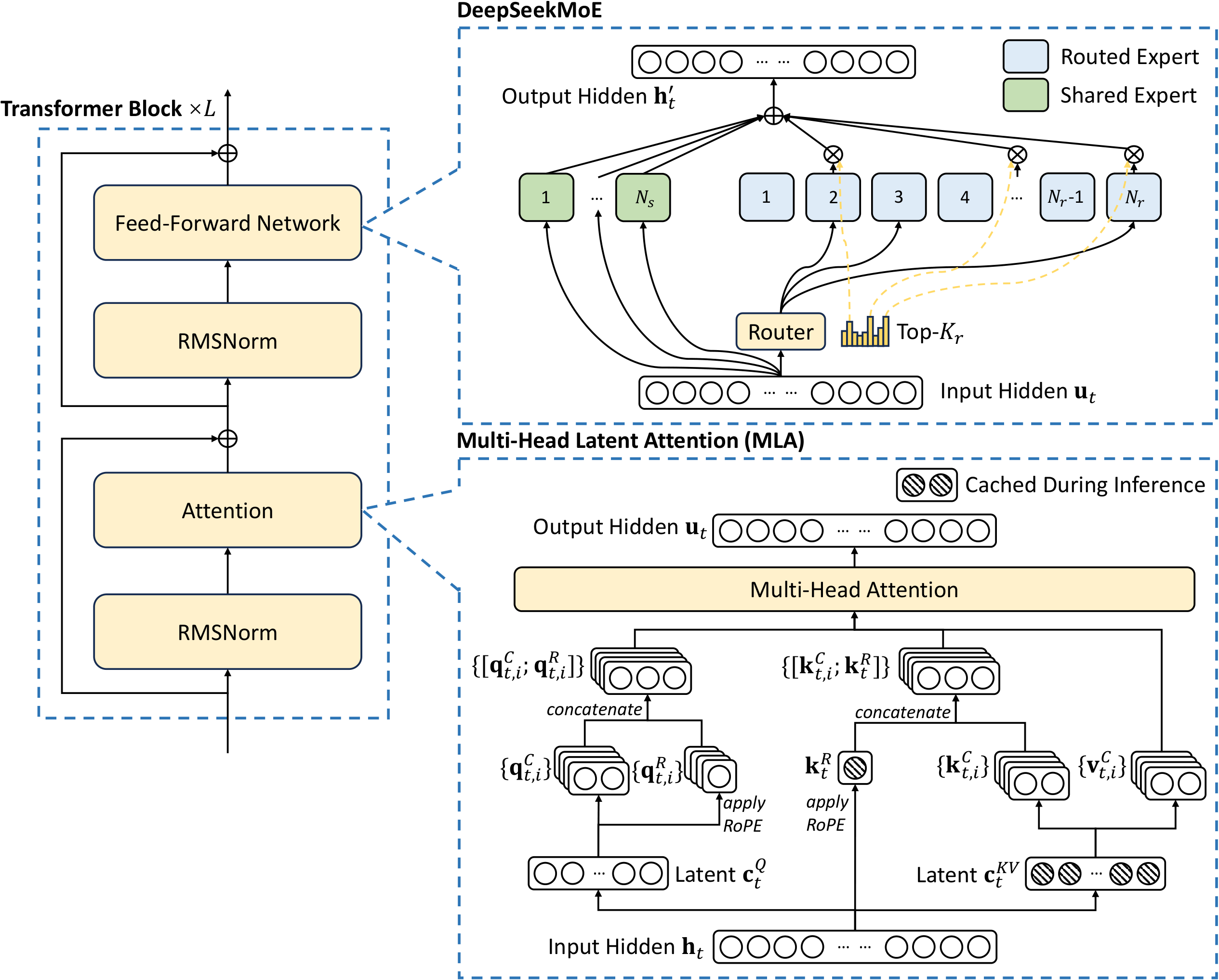
图:DeepSeek-V3 的基础架构(右侧即 DeepSeekMoE)。每个 MoE layer 有少量始终激活的 shared expert 和大量细粒度 routed expert,router 为每个 token 选 top-k routed expert。本组文档分析的正是这条通路:token 如何被 router 选中,dispatch 到 expert 所在 rank,经过 grouped GEMM,再由 combine 加权送回。(DeepSeek-AI 2024, Fig 2;arXiv:2412.19437)
2. 三层抽象与三个代码库的分工¶
MoE+EP 的实现天然分三层,三个代码库恰好各管一层:
┌─────────────────────────────────────────────────────────────┐
│  Layer 0  模型逻辑 / 编排                                       │
│  Megatron MoELayer:  route → dispatch → expert → combine       │
│  (moe_layer.py, router.py)                                     │
├─────────────────────────────────────────────────────────────┤
│  Layer 1  Token routing 的「重排 + 通信」                       │
│  MoETokenDispatcher 抽象:                                       │
│    - MoEAllGatherTokenDispatcher   (AG + RS, 老路径)            │
│    - MoEAlltoAllTokenDispatcher    (原生 A2A + 两次 permute)    │
│    - MoEFlexTokenDispatcher        (调用 DeepEP / HybridEP)     │
│  (token_dispatcher.py, fused_a2a.py)                           │
│        │                                                       │
│        └── 把 permute + all-to-all 融合下沉到 ↓                 │
├─────────────────────────────────────────────────────────────┤
│  Layer 2a 通信 kernel        │  Layer 2b 计算 kernel            │
│  DeepEP                      │  DeepGEMM                        │
│  dispatch / combine          │  m_grouped_*_contiguous (训练)   │
│  normal & low-latency        │  m_grouped_*_masked     (decode) │
│  (deep_ep/, csrc/kernels/)   │  k_grouped_* (wgrad)             │
└─────────────────────────────────────────────────────────────┘
- Megatron 决定「token 怎么路由、metadata 怎么算、前反向怎么挂 autograd」。
- DeepEP 把「permute + all-to-all + 接收端按 expert 落位」做成一个 fused、低 SM 占用、支持 FP8 的通信原语。
- DeepGEMM 把一系列 shape 相同、token 数不同的 expert GEMM 做成一个 m-grouped kernel,由一个 tile scheduler 跨 group 调度。
这三者的接缝是本组文档反复强调的重点:DeepEP dispatch 的输出 layout,必须正好是 DeepGEMM grouped GEMM 想要的输入 layout(按 expert 连续、每段按 M tile 对齐)。这个「layout 契约」是整个 MoE infra 设计的核心。
3. 并行维度:EP / TP / ETP / DP 的耦合¶
MoE 训练里同时存在多种并行,token dispatcher 必须同时处理。先固定符号(与 token_dispatcher.py:L40–L48 一致):
H   = hidden size
B   = micro batch size
S   = sequence length
TP  = tensor model parallel size
EP  = expert model parallel size
num_local_tokens  = S/TP * B          # 本 rank 持有的 token 数
num_global_tokens = num_local_tokens * TP * EP
E   = num_moe_experts (全局 expert 数)
num_local_experts = E / EP            # 本 rank 上的 expert 数
几个必须分清的并行域:
| 并行 | 切什么 | MoE 里的含义 |
|---|---|---|
| EP (Expert Parallel) | 把 \(E\) 个 expert 切到 \(\mathrm{EP}\) 个 rank,每 rank \(E/\mathrm{EP}\) 个 | dispatch/combine 的 all-to-all 就发生在 EP group 内 |
| TP (Tensor Parallel) | 切每个 expert 的权重矩阵(fc1/fc2 的 hidden 维) | expert 内的 GEMM 被切;dispatch 后还需在 TP 维 all-gather token |
| ETP (Expert TP) | MoE 部分独立的 TP(可与 attention 的 TP 不同) | Megatron 用 expt_tp_group(token_dispatcher.py:L75) |
| DP/CP | 数据 / context 并行 | router 的 aux loss 需要跨 DP 同步统计 |
生产级 MoE(DeepSeek-V3 一类)倾向
ETP=1:expert 不再按 hidden 维切,dispatch 后也不再 AG。原因见 Tensor Parallelism (TP) 与 Sequence Parallelism (SP) §7。Megatron 仍保留 ETP,是为了兼容 dense 时代的切法。
关键点:routing 是在 token 维上做的稀疏选择,而 EP 是在 expert 维上做的切分。一个 token 选中的 top-k 个 expert 可能分散在不同 EP rank 上,所以必须 all-to-all。Megatron 的 MoEFlexTokenDispatcher 把通信域定义为 TP×EP 的合并 group(token_dispatcher.py:L1395–L1472),用一个统一的 routing_map: [num_local_tokens, world_size, num_local_experts] 屏蔽 TP 和 EP 的差异,让 dispatch 逻辑与具体并行策略解耦。
DeepSeek-V3 风格的 group-limited routing(
moe_utils.py:579 group_limited_topk)正是为了控制 all-to-all 的扇出:把 expert 分组,每个 token 只能落到group_topk个组(相当于把目的地限制到少数几个 node),从而压低跨机流量。详见 01 · Router 与 Dispatch 前的 Preprocess。
4. 三种 token dispatcher 的取舍¶
Megatron 提供三种 dispatcher(moe_layer.py:L299–L322 按 config.moe_token_dispatcher_type 选择):
flowchart LR
    subgraph AG["allgather (老)"]
        direction TB
        ag1["AG(TP×EP) 把所有 token 收齐"] --> ag2["本地挑出属于 local expert 的 token + permute"] --> ag3["expert"] --> ag4["RS(TP×EP) 散回"]
    end
    subgraph A2A["alltoall (主力)"]
        direction TB
        aa1["permute-1 (按 expert 排)"] --> aa2["A2A(EP)"] --> aa3["AG(TP)+permute-2"] --> aa4["expert"] --> aa5["逆向"]
    end
    subgraph FLEX["flex (DeepEP/HybridEP)"]
        direction TB
        fl1["topk→indices"] --> fl2["fused_dispatch\n(permute+A2A 融合)"] --> fl3["multihot+permute(align)"] --> fl4["expert"] --> fl5["fused_combine"]
end- allgather(
MoEAllGatherTokenDispatcher,token_dispatcher.py:L212):实现最简单,但需要在 TP×EP 组内把全量 token 收发一遍,带宽浪费严重,目前已基本被取代。 - alltoall(
MoEAlltoAllTokenDispatcher,token_dispatcher.py:L354):当前训练的主力路径。它只发送每个 rank 真正需要的 token,通信量最优;代价是 split sizes 是运行时动态确定的,需要一次 D2H sync 才能让 CPU 拿到具体数值(见 02 · Dispatch:permute、all-to-all、buffer 分配 中关于 sync point 的讨论)。 - flex(
MoEFlexTokenDispatcher,token_dispatcher.py:L1395):把 permute+all-to-all 下沉给 DeepEP / HybridEP 的 fused kernel,少一次显存往返、SM 占用更低,且原生支持 FP8 dispatch。生产级大规模 EP(DeepSeek-V3 一类)采用这条路径。
后续文档以 alltoall + flex(DeepEP) 两条路径为主线展开,allgather 仅作对照。
5. forward / backward 的对称性¶
整条链路在 backward 时是严格镜像的,这是理解 MoE infra 最有效的一条线索。下面这张对称表会在后面每一段反复用到:
| forward 算子 | backward 算子 | 代码锚点 |
|---|---|---|
permute (index_select) |
unpermute (scatter_add) |
moe_utils.py:299 / 432 |
all_to_all(out_splits, in_splits) |
all_to_all(in_splits, out_splits)(splits 互换) |
token_dispatcher.py:678 / 837 |
| dispatch | combine | fused_a2a.py:71 FusedDispatch.backward → buffer.combine |
| combine | dispatch | fused_a2a.py:165 FusedCombine.backward → buffer.dispatch |
| grouped GEMM fc (m-grouped) | dgrad (m-grouped) + wgrad (k-grouped) | 05 · Grouped GEMM 与 Expert 计算 |
| AllGather (TP) | ReduceScatter (TP) | token_dispatcher.py |
其中有一个核心事实值得单独强调:
MoE dispatch 的反向就是 combine,combine 的反向就是 dispatch。 这不是巧合:dispatch 是「按 routing_map 把 token scatter 到各 expert」,是一个线性的 gather/scatter 操作;其转置(反向)正好是「把梯度按同样的 map 加回去」,也就是 combine。DeepEP 因此只需实现 dispatch / combine 两个 kernel,autograd 把它们交叉绑定即可(
fused_a2a.py:141-162, 192-209)。
6. DeepSeek-V3 量级的示例数字¶
为了给后面出现的 shape 一个直观的参照,这里固定一组示例数字(接近 DeepSeek-V3 pretrain,引自 legacy.md:L19):
H = 7168            hidden
E = 256             routed experts (+1 shared)
top-k = 8           每 token 选 8 个 expert
EP = 8 / 16 / 32 …  expert parallel size
tokens/batch = 4096 每 rank
dispatch = FP8 (e4m3)   ;combine = BF16
由此可推出几个关键量级:
- 每 rank 输入
4096 × 7168BF16 ≈ 56 MB;FP8 dispatch 后 ≈ 28 MB + scale。 - 每个 token 要复制 8 份(top-k=8)发出去,因此 dispatch 的「逻辑发送量」约为 token 数的 8 倍;group-limited routing 把其中跨机的部分限制到至多 4 个 node。
- 接收端每个 local expert 收到的 token 数记录在
num_recv_tokens_per_expert_list[i]中,只有运行时才知道,而且各 rank、各 expert 都不同——这是 grouped GEMM 必须支持 masked / 动态 \(m\) 的根本原因。
这组文档怎么读¶
| 文件 | 内容 | 对应代码 |
|---|---|---|
README.md(本文) |
全景 pipeline、术语、并行维度、整体数据流、代码映射表 | moe_layer.py |
| 01 · Router 与 Dispatch 前的 Preprocess | router gating / top-k / group-limited routing / aux loss / routing_map;dispatch 前的 metadata 预处理(layout 计算);前反向 |
router.py, moe_utils.py, token_dispatcher.py::preprocess |
| 02 · Dispatch:permute、all-to-all、buffer 分配 | permute(permutation-1/2)、all-to-all、buffer 分配、CPU-GPU sync;两条路径:Megatron 原生 A2A dispatcher vs DeepEP fused dispatch | token_dispatcher.py, fused_a2a.py, moe_utils.py::permute |
| 03 · Combine 与 forward / backward 对称性 | combine(reduce + unpermute)、整条链路的前反向对称性、dispatch.bwd == combine 这一核心事实 |
token_dispatcher.py, fused_a2a.py |
| 04 · 系统侧负载均衡:EPLB、LPLB、UltraEP 与 MoonEP | EPLB/LPLB 的静态 placement 与动态 reroute,以及 UltraEP / MoonEP 的实时、zero-copy 路线 | eplb、lplb、ultraep、moonep |
ep_lab.ipynb |
纯 torch 手写 MoE+EP 前反向,用 torch.distributed 的 all_to_all 在本地(CPU/gloo)模拟真实多机通信,可在 Mac 上跑 |
—— |
算子/kernel 侧的三篇专题——expert 计算怎么落在 grouped GEMM 上、DeepEP dispatch/combine 通信 kernel 的内部机制、以及把整条链融合的 MegaMoE mega-kernel——已移至 MoE 章:05 · Grouped GEMM 与 Expert 计算、06 · DeepEP:V1 (legacy/NVSHMEM) 与 V2 (elastic/NCCL Gin)、07 · MegaMoE:把 MoE forward 融成单个 kernel。本章保留全流程逻辑,三篇专题承接本章
02/03阅读。
建议顺序:先读完本文建立整体图景,再按 01 到 03 的顺序走通主链路(router/preprocess、dispatch、combine/backward),04(系统侧负载均衡)是进阶专题;expert 计算(grouped GEMM)、DeepEP 内部机制、MegaMoE 融合 kernel 三篇算子/kernel 专题见 MoE 章 05–07;最后做 lab 把每一段亲手实现一遍。
参考代码¶
代码事实以各项目固定 commit 的上游 GitHub permalink 为准;本地镜像只用于检索:
- Megatron-LM MoE —— MoE layer、router、token dispatcher、grouped experts
deepep—— EP all-to-all 通信库(V1 legacy / V2 elastic)deepgemm—— grouped GEMM kernel 库
下一篇:01 · Router 与 Dispatch 前的 Preprocess —— 从 logits 到 routing_map,以及 dispatch 之前那段容易被忽略的 metadata 预处理。